

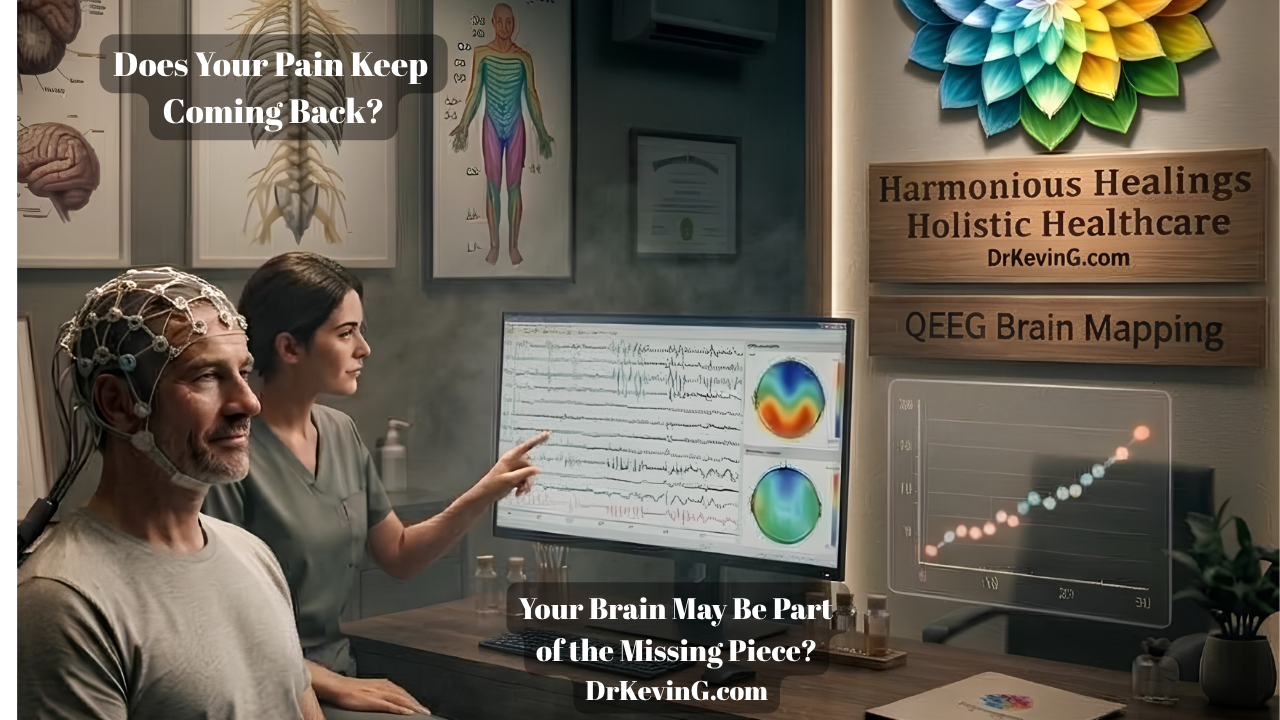
When the Pain Keeps Coming Back
Could Your Brain Be Part of the Missing Piece?
Have you ever had a massage, chiropractic adjustment, physical therapy session, stretching treatment, or other type of bodywork and thought:
“That feels so much better.”
Then, a few days later, the tightness returns.
Your neck stiffens. Your shoulders tighten. Your back begins to ache again. Your posture falls back into the same pattern. So you go back for more treatment.
Hands-on care can be extremely valuable. Muscles, joints, old injuries, weakness, inflammation, repetitive movements, and lifestyle all play important roles in how your body feels.
But there may be another part of the picture:
Your body is controlled by your nervous system.
Every second of every day, your brain is receiving information from your muscles, joints, tendons, eyes, inner ear, and other sensory systems.
Your brain and cerebellum use that information to answer questions such as:
- Where is my body in space?
- Am I balanced?
- Which muscles should tighten?
- Which muscles should relax?
- How much force is needed?
- Do I need to protect this area?
- How should I adjust my posture?
Most of this happens automatically.
Even when you are simply standing still, your nervous system is making countless tiny corrections to keep you upright.
Your Brain and Body Are Constantly Communicating
Think of the nervous system as a continuous loop:
Brain → Spinal Cord → Nerves → Muscles → Movement
Then information travels right back:
Muscles + Joints + Tendons → Nerves → Brain
Your posture, balance, coordination, and movement are therefore not simply mechanical.
They are also neurological.
The cerebellum—one of the brain’s major movement and coordination centers—helps compare what your body was supposed to do with what actually happened. It then helps the nervous system make corrections.
That happens over and over, thousands of times throughout your day.
What Happens When the Nervous System Learns the Wrong Pattern?
The nervous system is incredibly good at learning.
That is how you learn to ride a bicycle, play a sport, type on a keyboard, or swing a golf club.
But the nervous system can also adapt to injury, pain, stress, poor movement, repetitive work, and years of compensation.
For example, after an injury you and your body automatically begin protecting one area. Then watch what happens next….
Other muscles compensate. > Then your posture changes > Then your global movement changes > and eventually, that new pattern can begin to feel “normal.”
Even after the original problem improves, the nervous system may continue using the pattern it learned.
This does not mean that every recurring physical problem comes from the brain.
But it does mean that the nervous system deserves consideration—especially when the same physical patterns keep returning.
5 Signs Your Brain May Be Part of Your Recurring Physical Pattern
You may want to look more closely at nervous-system function if:
1. Your bodywork helps, but the improvement never seems to last.
You repeatedly feel better after treatment, but your body quickly returns to the same tension or postural pattern.
2. The same muscles keep tightening again and again.
Even with stretching, massage, exercise, or adjustments, certain areas seem determined to return to their old pattern.
3. Stress immediately affects your body.
Your neck, shoulders, jaw, back, or other muscles tighten dramatically when you are under pressure.
4. You have difficulty relaxing physically or mentally.
Your nervous system may seem like it is constantly “on,” even when there is no immediate reason to be on high alert.
5. Pain, balance, coordination, sleep, focus, or physical performance seem connected.
These functions may appear unrelated, but they all depend heavily on how the nervous system processes and regulates information.
So What Is a Brain Map?
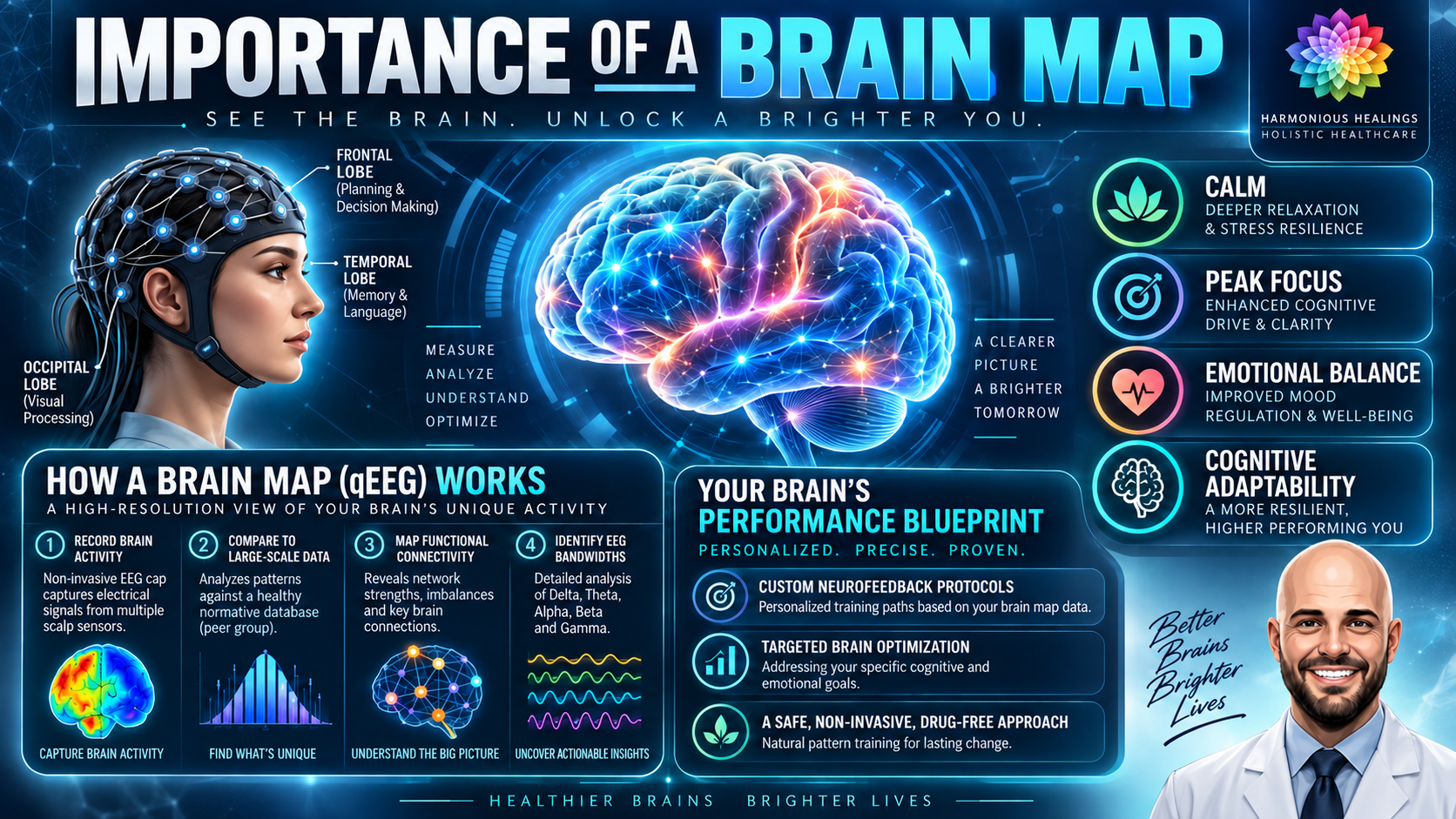
A qEEG, or quantitative EEG brain map, measures electrical activity recorded from the scalp.
It evaluates patterns of brain-wave activity such as:
Delta • Theta • Alpha • Beta
Depending on the type of analysis, the brain map may also evaluate how activity is distributed across different areas of the brain and how various brain regions appear to be functioning together.
A brain map does not diagnose a tight muscle, torn ligament, disc problem, or joint injury.
Instead, it asks a different question:
“How is the brain regulating itself?”
For someone struggling with ongoing physical tension, stress, poor sleep, pain, concentration problems, or recurring movement patterns, that can be extremely useful information to add to the overall picture.
What Is Peak Performance Neurofeedback?
If brain mapping is the assessment, neurofeedback is the training.
During neurofeedback, sensors monitor brain-wave activity while specialized software provides real-time feedback to the nervous system.
Through repeated training, the brain has an opportunity to learn more efficient patterns of regulation.
This ability of the nervous system to change and adapt is known as neuroplasticity.
At Harmonious Healings, our approach is not designed around giving everyone the same “cookie-cutter” training.
The goal is to use information from the individual’s brain map to help guide a personalized Peak Performance Neurofeedback Brain Training program.
Depending upon the individual, training may focus on areas involving:
- Nervous-system regulation
- Stress response
- Attention and focus
- Sleep regulation
- Sensory processing
- Mental performance
- Sensorimotor function
- Overall brain efficiency
Maybe the Missing Piece Isn’t More Bodywork
The answer is not necessarily Body OR brain.
The body and brain were never separate systems.
Chiropractic care can improve mechanics and nerve communication.
Massage may reduce muscular tension and enhance relaxation
Exercise and rehabilitation may strengthen and retrain the body.
And brain mapping with neurofeedback will allow us to see and train another important part of that same system, the part that coordinate and regulates all things:
The nervous system helping control it all.
So if you keep finding yourself saying:
“I feel better after treatment—but it just keeps coming back,”
it may be time to ask a different question:
What if we not only work on the muscles that keep tightening or the organ and gland dysfunction…
but also investigate and optimize the brain and central nervous system helping control coordinate those muscles, glands ad organs?
Discover What Your Brain Is Doing
At Harmonious Healings Holistic Healthcare, qEEG Brain Mapping and individualized Peak Performance Neurofeedback Brain Training provide a way to look beyond symptoms and better understand how your nervous system is functioning.
- Measure the brain.
- Understand the patterns.
- Train the nervous system.
- Help the brain and body work together more efficiently.




Leave A Comment